





























Earth Overshoot Day: July 30, 2026. Starting tomorrow, we will be taking more from nature than it can regenerate in a year.
Earth Overshoot Day indicates that the global economy is contributing to an ever-increasing depletion of the planet’s natural resources. This unsustainable trajectory contributes to the acceleration of climate change, exacerbates resource shortages, and poses an ever-greater risk to all those who fail to prepare in time for the challenges ahead. The calculation and the date were provided by the Global Footprint Network (GFN) and the University of York. The GFN is the international sustainability organization that introduced the concept of the Ecological Footprint; the University of York prepares the national Footprint and biocapacity calculations under the direction of the Footprint Data Foundation (FODAFO).
Every decision counts: let’s push back the day of overshoot!
Humanity is using up nature’s resources at a faster rate than ever before—about 73% faster than the rate at which the Earth’s ecosystems can regenerate them. According to the calculations, this is equivalent to the use of 1.73 Earths. Depleting natural capital at this rate threatens long-term resource security. The consequences are evident in deforestation, soil erosion, the loss of biodiversity, and the accumulation of CO₂ in the atmosphere, which contributes to more frequent extreme weather events and a decline in food production.
The Calculation
For more information on how Earth Overshoot Day is calculated, see: How Earth Overshoot Day 2026 Was Calculated – Earth Overshoot Day
The date is determined based on the latest edition of the National Footprint and Biocapacity Accounts (2026 edition). The Global Footprint Network estimated the projected results for 2026 based on preliminary and indicative data. The reports contain comprehensive data through 2023 and estimates for 2024 and 2025.
The data used to calculate the Ecological Footprint and biocapacity are provided by UN agencies and partner organizations. The data sets are regularly updated, and previous results are revised. A significant change this year resulted from the ocean’s carbon dioxide absorption capacity being estimated to be greater than previously thought. This correction, along with a few minor adjustments, pushed Earth Overshoot Day back by eight days compared to the 2025 estimate.
It is important to note that the shift in Earth Overshoot Day is the result of this correction and does not indicate an actual reduction in overshoot.
The negative trend continued, and the gap between humanity’s ecological footprint and the planet’s biocapacity widened further. July 30, 2026, marks the highest level of ecological overshoot to date.
The graph shows the trend in Earth Overshoot Days, recalculated based on the latest data from the 2026 edition.
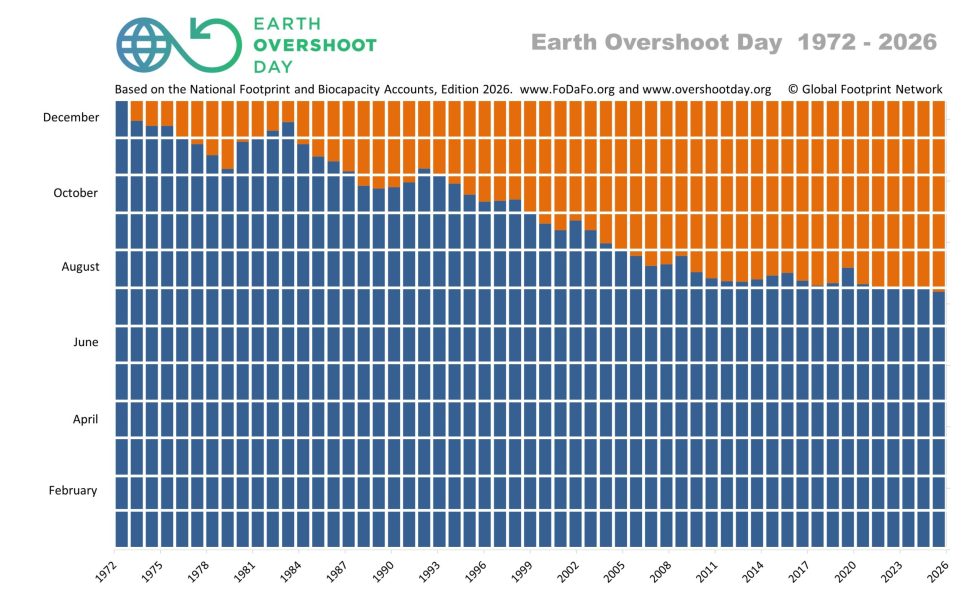
Figure 1: Earth Overshoot Days over the years. Source: Global Footprint Network, www.overshootday.org
We owe the Earth 20.6 years—let’s stop this trend!
Earth Overshoot Day has remained relatively stable over the past decade, but it still arrives too early in the year. For the remainder of the year, humanity lives off the depletion of natural capital, further degrading the state of the biosphere. Even if the date remained unchanged from one year to the next, the pressure on the planet would continue to grow due to the accumulation of damage caused by overuse.
Since global ecological overshoot began in the early 1970s, annual deficits have accumulated into an ever-growing ecological debt. This debt currently corresponds to 20.6 years’ worth of the Earth’s biological productivity. If ecological overshoot were fully reversible, it would take 20.6 years of the planet’s total regenerative capacity to restore the lost balance. Although this is a theoretical indicator, the ecological debt it signifies is likely no longer fully reversible.
If overconsumption continues at current levels, this debt will increase by approximately 0.73 planetary years annually. One measurable consequence of cumulative overconsumption is the rise in atmospheric CO₂ levels: since the onset of global overshoot in 1972, the concentration of greenhouse gases in the atmosphere—according to NOAA estimates—has risen from 367 parts per million (ppm) CO₂ equivalent to 547 ppm CO₂ equivalent by 2026.
“We are pushing the limits of how much ecological damage we can still cause with impunity—we are a quarter of the way through the 21st century, and we already owe the planet 20 years of ecological regeneration, even if we were to stop causing any further ecological damage starting today. If we want to continue to consider this planet our home, addressing the current situation will require adaptation and mitigation efforts on a scale unprecedented in human history.” – comments Dr. Lewis Akenji, a board member of the Global Footprint Network.
Consequences – the decision is in our hands!
Dr. Mathis Wackernagel, a board member of the Global Footprint Network, states: “Due to the laws of physics, overconsumption cannot last forever. It will end either through conscious planning or as a result of a catastrophe befalling us. It is not difficult to decide which path we would choose, and we have numerous options at our disposal.”
This year, in collaboration with its partner organizations, the Global Footprint Network is examining what steps individual countries are taking to reduce overconsumption and how they are preparing for a future characterized by extreme weather and resource scarcity.
We have only one Earth—it’s time to manage it accordingly!
As part of the #MoveTheDate movement launched by the Global Footprint Network, we can explore numerous ways to push back Earth Overshoot Day. Many of these are financially beneficial as well. The Power of Possibility platform focuses on five key areas: a healthy planet, cities, energy, food, and population. For example, a 50% reduction in CO₂ emissions from fossil fuels would push Earth Overshoot Day back by three months. More examples can be found here: #MoveTheDate.
Some companies are already evolving in the spirit of the #MoveTheDate initiative. Companies that adapt their operations to the challenges of climate change and dwindling resources can gain a long-term competitive advantage. Demand for the solutions listed is expected to grow, while companies will become less vulnerable to ecological constraints. Companies that describe themselves as “regenerative” or “circular” must credibly demonstrate that they are truly contributing to reducing global overconsumption.
Katalin Herner, executive director of the KÖVET Association, emphasizes: “We can push back Overshoot Day not with a single major step, but through thousands of conscious decisions—such as energy efficiency improvements, circular economy solutions, emissions reductions, responsible procurement, and the conservation of natural resources. For 30 years now, the KÖVET Association has been working to help companies reduce their environmental impact and increase their resource efficiency through practical solutions. Together with our member companies and partners, we believe that responsible business practices serve both economic success and the preservation of natural values.”
Further information:The ecological footprint is the most comprehensive biological resource accounting indicator available. Based on 15,000 data points per country per year, it aggregates people’s competing demands on biologically productive areas—food, timber, fiber, carbon sequestration, and infrastructure. Currently, the carbon footprint—that is, carbon dioxide emissions resulting from the burning of fossil fuels—accounts for 61 percent of humanity’s ecological footprint. The National Footprint and Biocapacity calculations are currently produced by FoDaFo in collaboration with York University in Toronto. The Global Footprint Network is an international sustainability organization that helps the world live within the Earth’s resource limits and respond to climate change.
Since 2003, they have been working with more than 50 countries, 30 cities, and 70 global partners to provide scientific insights that lead to high-impact policy and investment decisions. “Together, we are shaping a future in which we can all thrive within the limits of our one and only planet.” www.footprintnetwork.orgThe KÖVET Association for a Sustainable Economy (hereinafter KÖVET) is a public-benefit, non-profit organization. Its long-term goal is to help organizations on the path to sustainability; thus, in addition to environmental protection, it places great emphasis on companies’ social and local economic responsibilities. Among its approximately 70 member organizations, KÖVET promotes the exchange of experiences and the sharing of best practices, and develops, promotes, and applies methods that serve environmental, social, and economic interests alike. The Association is a collaborating partner of the Global Footprint Network (GFN). www.kovet.hu
- About the Ecological Footprint
- The Global Footprint Network
- KÖVET Association for a Sustainable Economy
Contact: Imola Biró, Communications Director, KÖVET Association for a Sustainable Economy (+36203172389 | biro@kovet.hu | www.kovet.hu )


